Spectroscopy and biosignatures: How we'll find evidence of life on other planets

First published on 22nd April 2017. Last updated 1 January 2020 by Dr Helen Klus
Scientists have found thousands of planets outside of the Solar System, many of which are thought to be habitable. The next step is to search for signs of life. While this may be possible with current and upcoming telescopes, like the Hubble Space Telescope (HST) and the James Webb Space Telescope (JWST), NASA is currently considering two projects that will be able to directly image Earth-like planets. »
Life in crystals: The science of crystal gems

First published on 26th February 2017. Last updated 1 January 2020 by Dr Helen Klus
Crystals are objects with atoms that are arranged periodically. This can be seen on a large scale as they form natural cubes, triangles, or more complex symmetrical shapes like snowflakes. Many crystals are minerals. Minerals are naturally occurring solids with a potentially crystalline structure that are not made by life forms. They are made from single elements or molecules that form a repeating pattern. New atoms attach in such a way that the pattern is repeated on every scale, making them natural fractals. »
A brief history of dinosaurs: From sauropods to hummingbirds

First published on 17th January 2017. Last updated 1 January 2020 by Dr Helen Klus
In the 20th Century, most people thought that all dinosaurs were lizard-like and extinct. We now know that dinosaurs are not lizards and that birds are a type of dinosaur. Scientists now refer to modern birds as avian dinosaurs and to extinct dinosaurs as non-avian dinosaurs, many of which had feathers and beaks. »

First published on 26th February 2018 by Dr Helen Klus
Homophobia, transphobia, and sexism may all stem from the idea that people can be easily categorised. If there are only two genders that can be identified from birth, and everyone with the same gender acts the same way, then a world of 7 billion people seems less daunting. This is a childish fantasy. People from cultures all around the world have identified as genders other than male and female, as genders other than their sex, and as sexualities other than straight throughout recorded history. »
Carl Sagan and space exploration: The effects of popularising science

First published on 6th April 2016. Last updated 1 January 2020 by Dr Helen Klus
In the 1960s, science journalism in the United States was sparse and mostly performed by journalists with little or no scientific background. Science was perceived as minimising the need for pseudoscience, but it didn't fill the spiritual void this left in people. »
Water in space: Evidence of flowing liquid water on Mars

First published on 29th September 2015. Last updated 1 January 2020 by Dr Helen Klus
In September 2015, NASA announced that they've found evidence of liquid water currently flowing on Mars. This began with the discovery of dark streaks on the sides of several craters. These are up to a few hundred meters long, and appear seasonally. »
Sex and gender: Pioneering transgender and genderqueer scientists

First published on 16th July 2015. Last updated 1 January 2020 by Dr Helen Klus
Many scientists used to think that there are only two genders, male and female, and that a person's gender can be solely determined from their genitals or chromosomes. We now know that this is not the case. While a person's sex can, by definition, be determined from their genitals or chromosomes, gender is much more complex than this. »
Robot Dreams: Artificial neural networks and Google's Deep Dream

First published on 7th July 2015. Last updated 1 January 2020 by Dr Helen Klus
In June 2015, a team of software engineers working for Google released images created by programs designed for image recognition software. Image recognition software works by using artificial neural networks, which attempt to mimic neural networks in the brain. Information is input, artificial neurons process the image, and the identification is output. »
From Salvador Dali to Monty Python: Artists inspired by science

First published on 4th August 2014. Last updated 1 January 2020 by Dr Helen Klus
Scientists often utilise the same tools as artists to record or illustrate their ideas. They may create computer-generated images to use in academic papers, animations to show during presentations, or models to educate the public, and scientific organisations and agencies often employ artists to do this for them. »
Pseudoscience, ethics, and meaning: The relationship between philosophy and science

First published on 9th June 2014. Last updated 1 January 2020 by Dr Helen Klus
Science has a massive impact on everyone. How we teach it, and what we decide to fund, can literally have life and death consequences for millions of people. This means it's vital that everyone has a good understanding of what science is and how it affects them. »
From mammoths to people: A brief history of cloning

First published on 27th April 2014. Last updated 1 January 2020 by Dr Helen Klus
In April 2014, scientists in South Korea and the United States announced that they had cloned a human embryo, which could have developed into a foetus if it had been implanted into a surrogate mother. Cloning is the process of producing genetically identical individuals. This happens naturally in all asexual reproduction and in sexual reproduction when identical siblings are born. »
Neutron stars, magnetars, and X-ray binaries: The most magnetic objects in the universe

First published on 8th December 2013. Last updated 1 January 2020 by Dr Helen Klus
For the last two years, I have been researching neutron stars at the University of Southampton, supervised by Professor Malcolm Coe and Dr Wynn Ho, and we have recently made a surprising discovery. Neutron stars are the most magnetic objects in the universe, with some having magnetic fields so high that quantum behaviour comes into effect. »
From the first particle accelerators to the discovery of the Higgs boson: A brief history of CERN

First published on 30th July 2013. Last updated 1 January 2020 by Dr Helen Klus
Before construction began on the European Organization for Nuclear Research (CERN) in 1954, the atom was known to be composed of electrons (an elementary particle, and a type of lepton), and a nucleus containing neutrons and protons (which are hadrons, particles now known to be made of smaller particles called quarks and gluons), and all of these particles were thought to have an antimatter partner. »
Famous female scientists: A timeline of pioneering women in science
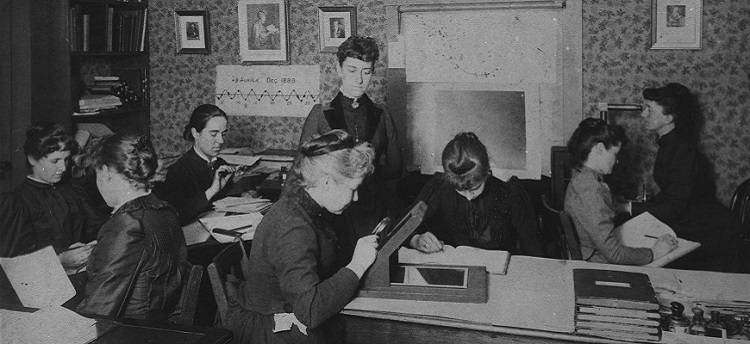
First published on 12th May 2013. Last updated 1 January 2020 by Dr Helen Klus
Women are massively under-represented in physics and other STEM (science, technology, engineering, and mathematics) subjects at all levels. A report by the Institute of Physics, using data from 2011, showed that 46% of schools in the UK had no girls continue to study physics after the age of 16. »
X-ray emissions, detectors, and telescopes: A brief history of X-ray astronomy

First published on 7th October 2012. Last updated 1 January 2020 by Dr Helen Klus
June 18th 2012 marks half a century since the first X-ray source was discovered outside of the Solar System. This began a race to map the X-ray sky, leading to the discovery of the most extreme objects in the universe. »
Imagining the future: Why society needs science fiction

First published on 3rd April 2012. Last updated 1 January 2020 by Dr Helen Klus
While there's no single accepted definition of science fiction, science fiction usually deals with worlds that differ from our own as the result of new scientific discoveries, new technologies, or different social systems. It then looks at the consequences of this change. »

First published on 14th October 2011. Last updated 1 January 2020 by Dr Helen Klus
The desire to explore our surroundings is part of human nature. It's that which drove our ancestors to leave Africa tens of thousands of years ago, walking across continents, and traversing unmapped oceans in simple rafts. »
A brief history of mathematics: From Plato's philosophy of mathematics to modern mysteries

First published on 11th July 2011. Last updated 1 January 2020 by Dr Helen Klus
There's evidence that prehistoric people understood simple mathematics, as well as astronomy. The oldest evidence comes from the Lebombo bone, which is about 37,000 years old and was found in Swaziland. »
Animals in space from fruit flies to Laika: A brief history of animal astronauts

First published on 22nd May 2011. Last updated 1 January 2020 by Dr Helen Klus
Last week, the Space Shuttle Endeavour left Earth for the final time, carrying banana spiders and fruit flies to the International Space Station. They are the latest in a long line of animal astronauts. Literally thousands of animals have been to space, including 32 monkeys, two cats, and at least 27 dogs. »
Oberth, Spitzer, and Hubble: A brief history of the Hubble Space Telescope

First published on 24th April 2011. Last updated 1 January 2020 by Dr Helen Klus
April 24th 2011 marks the 21st anniversary of the launch of the Hubble Space Telescope and NASA has released a new image to mark the occasion. This shows the interaction of spiral galaxy UGC 1810 with its companion UGC 1813. The success of the HST took decades of persistence and hard work. »