
2.1 Reflection
The Ancient Greek mathematician Euclid described the law of reflection in about 300 BCE. This states that light travels in straight lines and reflects from a surface at the same angle at which it hit it.
Light is reflected in the same way that a ball would bounce off of a frictionless surface, and so Euclid claimed that light travels in rays that are discrete, like atoms, not continuous, like waves. This may mean that some of the objects in our visual field will always remain unilluminated, and therefore undetected. Unlike Aristotle, Euclid thought that light is emitted in rays from the eye.[1]
Law of reflection
| Angle of incidence (θi) = Angle of reflection (θr) | (2.1) |
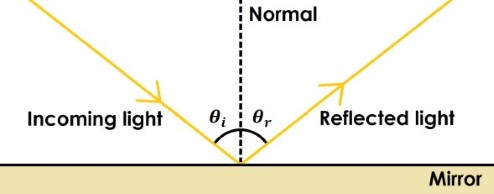
Figure 2.1 |
Reflection. |
2.2 Refraction
The Roman astronomer Ptolemy first tried to experimentally derive the law of refraction in the 2nd century CE.[2] Refraction explains how a ray of light changes direction when it travels between different mediums. This is either because it slows down or because it speeds up. Refraction occurs when light hits the surface of water or travels through the atmosphere, and it’s atmospheric refraction that causes the stars to ‘twinkle’.
Ptolemy measured the angle that a beam of light hits a boundary, the angle of incidence, and the angle at which it leaves, the angle of refraction, through different mediums. He discovered that the angle of incidence is proportional to the angle of refraction, but could not derive the full equation. Like Euclid, Ptolemy thought that light is emitted in rays from the eye.[3]
Ptolemy’s law of refraction
| Angle of incidence (θi) ∝ Angle of refraction (θrefr) | (2.2) |
The Iraqi mathematician Ibn Sahl discovered the full law of refraction in 984. Sahl showed that the angle of incidence is related to the angle of refraction using the law of sines.[4] Sahl couldn’t use this method to measure the actual speed of light, however, and could only determine the ratios.
Ibn Sahl’s law of refraction
| sin(θi)sin(θrefr) = vivrefr = nrefrni | (2.3) |
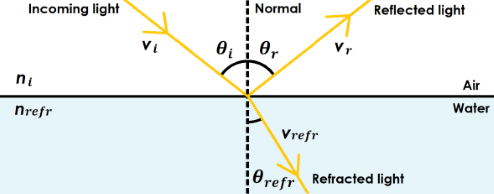
Figure 2.2 |
Refraction between air and water. |
Here v is velocity and n is the refractive index. n=c/v, where c is the speed of light in a vacuum, which is very close to its speed in air.
The Dutch mathematician Willebrord Snellius rediscovered the sine law of refraction in 1621. Snellius’ theory was not published in his lifetime and, in 1637, the French natural philosopher Rene Descartes rediscovered the law again, independently.[5]
The sine function
The sine function shows how the angle inside a triangle changes as the lengths of its sides change. The sine of an angle (θ) equals the ratio of two lengths - the length opposite the angle, and the longest length, the hypotenuse.

Figure 2.3 Image credit
| sin(θ) = opposite lengthhypotenuse | (2.4) |
In Figure 2.3,
| sin(A) = length alength c | (2.5) |
The sine of 90° is 1 because the opposite length will also be the longest, the hypotenuse. In the triangle above, sin(C) would equal length c / length c, which equals 1.
| Similarly, | cos(θ) = adjacent lengthhypotenuse | (2.6) |
| and | tan(θ) = opposite lengthadjacent length |
The ancient Greek astronomer Hipparchus created the first documented table of sine functions before 125 BCE.[6] Hipparchus’ work was referenced by Ptolemy over 250 years later, and so it’s not known why he didn’t derive the sine law of refraction himself.[7][8]
Sin, cos, and tan waves could not be represented graphically until after the invention of the Cartesian coordinate system by Descartes and the French mathematician Pierre de Fermat in 1637.[9]

Figure 2.4 |
A plot showing sin(θ), cos(θ), and tan(θ). |
2.2.1 Ibn al-Haytham
The Iraqi mathematician Ibn al-Haytham (also known as Alhazen) was the first person to correctly describe how perception occurs in about 1021 when he proved that light enters, but is not emitted by, the eye.[10] Al-Haytham stated that light consists of tiny particles of energy that travel in straight lines and emanate from the Sun at a large but finite velocity. Vision occurs when the Sun’s rays are reflected from objects and into our eyes.
Al-Haytham experimented with the laws of reflection and refraction using different shaped mirrors and lenses, and he accurately described how the eye functions as an optical instrument. He likened it to a camera obscura, a pinhole camera, and so suggested that images must also be inverted in the eye. This led him to suggest that vision occurs in the brain, rather than the eyes and that it is, therefore, subjective.[11]
Science began to progress again in Europe after the Renaissance of the 12th century. This was mainly due to increased contact with the Islamic world.[12] The English philosopher Roger Bacon, who was one of the earliest European advocates of experimental science, reviewed Al-Haytham’s Book of Optics in 1267, and it was translated into Latin shortly after.[13]
2.2.2 Rainbows
The German philosopher Theodoric of Freiberg (also known as Dietrich of Freiberg) explained how rainbows are formed in about 1307.
Theodoric did this by experimenting with spherical flasks, which he filled with water to represent raindrops. Theodoric showed that the light of the Sun is refracted, and then internally reflected, inside each drop.[7]
To see sunlight that has passed through a raindrop, there needs to be an angle of about 40°-42° between you, the raindrop, and the Sun. The set of all the raindrops that can be seen from this angle at once forms a cone pointing towards the Sun. Coloured light is not visible from any other angle, and so when you move, the rainbow moves with you. This is why you will never be able to reach the end of a rainbow.
In the case of a double rainbow, secondary bows are caused by double reflection inside the raindrop. This causes the colours to be reversed and produces visible light at about 52°-54°.

Figure 2.5 |
Rainbows form when light is refracted and then internally reflected inside raindrops. |
2.3 Diffraction
The Italian natural philosopher Francesco Grimaldi discovered and coined the term ‘diffraction’ in 1660.[14] Grimaldi showed that a single beam of light spreads out, creating an interference pattern, if it’s shone through very small slits. Water and sound waves act the same way, and so this was an important finding for those that advocated for a wave theory of light. Before this, people had argued that the sharp boundaries created by shadows meant that light could not bend around corners in the same way that water or sound waves can.
Grimaldi’s findings were published in 1665, two years after his death.[15] Diffraction is now understood in terms of the superposition principle (discussed in Chapter 5).

Figure 2.6 |
Waves spread out when they move through a slit. |