
8.1 The curvature of spacetime
In his theory of special relativity (discussed in Chapter 7), Albert Einstein showed that time and distance can be measured to have different values depending on their relative speed and direction. However, special relativity only applies to objects moving at a constant velocity. If an object accelerates, then the theory breaks down.
Einstein’s theory of general relativity applies special relativity to the concept of acceleration. Isaac Newton had already shown the equivalence between gravitational acceleration and ordinary acceleration (discussed in Chapter 5), and so general relativity unites theories of space and time with theories of light and matter.

Figure 8.1 |
The effects caused by acceleration and the effects caused by gravity are the same. |
Gravity can be equated with acceleration because the effects of a gravitational field can be produced by accelerating. In a closed room, there’s no experiment a person can conduct that will tell them if objects are falling because they are experiencing a gravitational force or because they are in deep space accelerating at the same rate.
Einstein realised that a gravitational field would cause objects to accelerate if Minkowski’s spacetime were curved. This acceleration is similar to when an object rolls down a curved surface. In this case, however, the amount of acceleration is higher for objects with a higher mass because a higher mass causes a deeper, longer curve.
This means that objects accelerate because of the curvature of spacetime, and we call this effect gravity.

Figure 8.2 |
Massive objects like stars curve spacetime in a similar way to how massive objects like a heavy ball will curve a stretched-out piece of fabric. A lighter object like a coin may spin around the curve created by the ball, just as a lighter object like a planet may spin around the curve created by the Sun. |
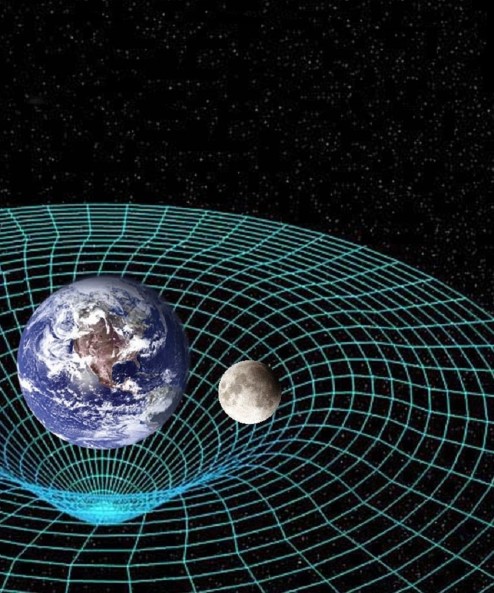
Figure 8.3 |
The moon spins around the curve - or gravitational well - created by the Earth. |
The relationship between spacetime and mass was summarised by the American physicist John Wheeler as follows,
Spacetime tells matter how to move; matter tells spacetime how to curve.[1]
Einstein showed how the curvature of spacetime is related to the distribution of matter using equations developed by the German mathematician Bernhard Riemann in the 1850s.[2]
| Gμν | = | Rμν - 12Rgμν | (8.1) |
| Gμν | = | 8πGc4Tμν | (8.2) |
Here, Gμν is the Einstein tensor, which describes the curvature of spacetime. Rμν is the Ricci tensor, which describes the relationship between Euclidean and non-Euclidean geometry. gμν is the metric tensor for Minkowski space, which describes all the intrinsic properties of the spacetime manifold, including time periods, distances, volumes, and the curvature, and finally, Tμν is the energy-momentum tensor, which describes the distribution of matter. The energy-momentum tensor is the source of the gravitational field, just as mass is the source of the gravitational field in Newton’s equations.
A tensor is like a vector, which contains two properties. Velocity, for example, is a vector as it represents speed in a given direction. A tensor contains more than two properties, which may be written in a matrix - numbers or symbols that are arranged in rows and columns.
General relativity shows that observers in any frame will agree on how spacetime is curved by objects and hence their gravitational field, whether they are moving relative the object or not. This means that the curvature of space and hence the force of gravity is invariant.
Light moves through curved spacetime taking the shortest possible path, however, the shortest path across a curved surface is not necessarily a straight line. The shortest path, which may be curved, is known as a geodesic. This meant general relativity predicted that the path of light is bent by heavy objects, like the Sun.
8.1.1 The cosmological principle
In order to apply his theories to the universe as a whole, Einstein applied the cosmological principle. This assumes that the universe is homogeneous and isotropic when averaged over very large scales.
Homogeneity assumes that our observations are representative of the whole universe, and isotropy means that the universe is the same in whichever direction we look. These ideas were formalised by the British astronomer Edward Milne in the 1930s,[3,4] and verified by NASA’s WMAP (Wilkinson Microwave Anisotropy Probe), which launched in 2001.
8.2 Confirmation of general relativity
Arthur Eddington confirmed general relativity after the 1919 solar eclipse. Eddington knew that if mass curves spacetime, then light would travel in a curved path as it approaches a massive object like the Sun. This means that if the glare of the Sun were blocked, like it is during an eclipse, he would be able to see stars that should be behind it. Einstein’s theory predicted that the gravitational force of the Sun can cause starlight to deflect by up to 1.75 arc seconds (0.0005°) and Eddington confirmed this.[5]

Figure 8.4 |
Eddington’s photograph of the 1919 eclipse with dashed lines showing the positions of stars. The stars appeared to have moved from their usual relative positions because their light is bent around the gravitational well of the Sun. |

Figure 8.5 |
The light from distant galaxies is affected by the curvature of spacetime caused by a massive cluster of galaxies - Abell 2218. This has caused images of the galaxies to be enlarged and duplicated in a process known as gravitational lensing. |
8.3 Consequences of general relativity
8.3.1 The precession of Mercury
The curvature of spacetime forces planets to orbit in open ellipses that are rotating. This effect is more noticeable the closer a planet is to the Sun, and so this explained why these effects were first observed in Mercury’s orbit.
8.3.2 Gravitational lensing
The curvature of spacetime means that the path of light is deflected around massive objects. This effect is known as gravitational lensing, and it can affect the shape of an event’s light cone (discussed in Chapter 7), allowing light to travel into previously forbidden regions. Gravitational lensing magnifies and brightens an image and it’s also possible for the same image to be projected more than once as light is deflected in different directions. Eddington showed that light is deflected around the Sun in 1919.
The Swiss astronomer Fritz Zwicky first considered using galaxy clusters as gravitational lenses in 1937.[6] These effects were first observed by the astronomers Dennis Walsh, Robert Carswell, and Ray Weymann at the Kitt Peak National Observatory in the United States in 1979.[7]
8.3.3 Gravitational waves
As massive objects move through spacetime, they change its curvature and this change will dissipate from the objects at the speed of light, creating ‘ripples’ in spacetime like ripples on a pond. These ripples are known as gravitational waves. Scientists in the LIGO (Laser Interferometer Gravitational-Wave Observatory) Scientific Collaboration and the Virgo Collaboration discovered evidence for gravitational waves from a pair of merging black holes in 2016.[8]

Figure 8.6 |
An artist’s impression of a binary star system containing two neutron stars. The neutron stars create curves in spacetime as they orbit each other, and these dissipate at the speed of light, creating waves. |
8.3.4 Black holes
Black holes (discussed in Chapter 14) occur when an object becomes so massive that even light cannot escape its gravitational well. We now know that supermassive black holes reside at the centre of most galaxies, including our own. These are millions of times the mass of the Sun.

Figure 8.7 |
The more massive the object, the more it curves spacetime, and the steeper the gravitational well. When an object is so massive that even light, which has no mass, cannot escape the well, the object is known as a ‘black hole’. |
8.3.5 Time travel
If mass curves space then it will also curve time, and in 1949 the Austrian mathematician Kurt Gödel suggested that time travel is possible because closed timelike curves can occur.[9] These are regions where time is curved so that an observer would find themselves in an earlier time. Time travel would violate our notion of causality, and so there’s still much debate over whether it’s really possible.
8.3.6 Gravitational time dilation
By 1907, Einstein had already predicted that gravity would create an effect similar to the Doppler effect (discussed in Chapter 7). Einstein predicted that from the point of view of a stationary observer, light will appear to be redshifted as it moves towards a strong gravitational force. This change corresponds to the fact that time appears to run slower for observers in a stronger gravitational field.[10]
‘Proper’ time, or invariant time (t), is related to the relative time measured by something moving towards or away from a gravitational field (trel) via,
| Δtrel = Δt√1 - 2Gmrc2 | (8.3) |
Gravitational time dilation was first observed in 1971 when the American physicists Joseph Hafele and Richard Keating flew four atomic clocks twice around the world on a commercial aeroplane and then compared their time to clocks left on Earth.[11,12]
All satellite navigation systems including Global Positioning Systems (GPS) have to take the effects of gravitational time dilation into account.

Figure 8.8 |
Gravitational time dilation means that light appears redder as it moves towards a gravitational field. |
8.3.7 Absolute space
Einstein suggested that general relativity disproves Newton’s idea that space and time exist independently of matter and energy as a type of substance (discussed in Chapter 5), stating that general relativity “takes away the last remnants of physical objectivity from space and time”.[13]
This is because in general relativity spacetime is no longer considered a background in which events take place. Instead, spacetime is affected by what it contains. All observable events are described by the metric tensor but there’s no unique coordinate system. The choice is arbitrary. This means that the actual shape of spacetime can be described in many different ways that all give the same observable results. No experiment can distinguish between them. If spacetime is a real substance, then it would presumably have to pick one of these shapes and this leads to the ‘hole’ argument.[14]
The hole argument shows that if you accept that coordinate systems do represent the true nature of spacetime, then there’s no reason why there couldn’t be a ‘hole’, where spacetime suddenly follows another coordinate system. There’s no way to determine when a hole will appear since both systems are observationally identical, and so proponents of absolute spacetime must accept that general relativity possesses the same objective uncertainty as quantum mechanics. If we remove the idea that spacetime is absolute then we don't face this problem.
8.3.8 A non-static universe
For Einstein, the most startling consequence of general relativity was that it shows that the shape of the universe depends on its energy density. This means that if all the mass in the universe is not sufficiently distributed, then everything will eventually fall in on itself, and the universe will end in a ‘big crunch’. Einstein devised the cosmological constant to counterbalance this force and create a static universe.
In 1922, the Russian mathematician Alexander Friedmann showed that it’s also possible that the universe is expanding.[15] This could occur if it began at an extremely high density and temperature. If this were the case, and if the mass is distributed too sparsely, then matter will continue to move apart forever.
Edwin Hubble proved that the universe is expanding in 1929[16] (discussed in Chapter 9). It’s now thought that the universe will expand forever due to dark energy, which was discovered in 1998.[17,18]