
19.1 Characteristics of Mars
Mars is the fourth-closest planet to the Sun and takes about 687 days to make one complete orbit. A day on Mars is less than an hour longer than a day on Earth.[1] Mars is the next brightest natural object in the sky after Venus, and like Mercury and Venus, Mars is named after a Roman god, the god of war.[2]

Figure 19.1 |
Mars, a mosaic of images taken by the Mars Global Surveyor Orbiter. |
Mars is red for the same reason that rust is red, because the iron on its surface is oxidised. Mars has a thin atmosphere, mostly composed of carbon dioxide, and its surface is covered in craters, inactive volcanoes, valleys, deserts, and ice caps. Mars hosts the largest volcano in the Solar System, Olympus Mons, and the largest canyon, Valles Marineris.[3]
Mars Fact Sheet[1]
| Designation | = | Terrestrial (rocky) planet |
| Mass | = | 6.4×10²³ kg (10.8% mass of Earth) |
| Radius | = | 3396 km (53.2% radius of Earth) |
| Density | = | 3933 kg/m3 (71.3% density of Earth) |
| Length of Day | = | 24.7 hours |
| Length of year | = | 687 Earth-days (1.9 Earth-years) |
| Days per year | = | 667.5 days on Mars per year on Mars |
| Distance from the Sun | = | 2.3×10⁸ km (1.5 AU) |
| Orbital Velocity | = | 24.1 km/s |
| Orbital Eccentricity | = | 0.094 |
| Obliquity (tilt) | = | 25.2° |
| Mean Temperature | = | -65 °C |
| Moons | = | 2 (Captured asteroids Phobos and Deimos) |
| Ring System | = | None |
19.2 Mars’ moons
19.2.1 Phobos and Deimos
Mars has two moons, Phobos and Deimos, which were discovered by the American astronomer Asaph Hall in 1877.[4] These are thought to be asteroids that were captured by Mars’ gravitational pull.[5]

Figure 19.2 |
Phobos. |

Figure 19.3 |
Deimos. |
Mariner 9 first photographed Phobos and Deimos in 1971. They were later photographed by Viking 1 and Viking 2 and many of the other missions bound for Mars in the 1990s and 2000s. In 1988, the Soviet Union launched two probes to Phobos: Phobos 1 and Phobos 2. The first was lost, and the second only relayed a small amount of data. The Russian Space Agency launched a mission to Phobos in 2011 known as Phobos-Grunt, but it was unsuccessful.
19.3 Missions to Mars
There have been over 40 attempts to send spacecraft to Mars, about 25 of which have been successful. The Soviet Union made eight failed attempts to launch a probe to Mars in the 1960s, starting with Mars 1960A and Mars 1960B in 1960, and Mars 1962A, Mars 1962B, and Mars 1 in 1962. These were followed by Zond 2 in 1964, and Mars 1969A and Mars 1969B in 1969.
NASA made its first attempt to send a probe to Mars in 1964, with Mariner 3 and Mariner 4. Mariner 3 did not send back any useful information, but Mariner 4 was successful and produced the first images of another planet ever to be returned from deep space. Mariner 5 went to Venus, but Mariner 6 and Mariner 7 successfully flew past Mars in 1969.
Mariner 8 and Mariner 9 were due to launch in 1971. Mariner 8 failed, but the Mariner 9 mission was successful. It became the first spacecraft to orbit another planet and remained in orbit for over a year. Mariner 9 found evidence for water on Mars and showed that it had once contained rivers, which formed large and complex canyons.
The Soviet Union launched 11 probes to Mars in the 1970s, starting with Cosmos 419, Mars 2, and Mars 3, which were launched in 1971. Cosmos 419 was a failure, but Mars 2 and Mars 3 were somewhat successful. It was planned for both Mars 2 and Mars 3 to land on the planet, and although Mars 2 crashed, it became the first human-made object to reach the Martian surface. Mars 3 landed successfully but only transmitted data for 14.5 seconds. Mars 2 and Mars 3 were followed by Mars 4 - Mars 7, which were all launched in 1973, and were all at least partially successful.
NASA launched Viking 1 and Viking 2 in 1975. These both contained an orbiter and a lander and were both successful. They returned the first colour photographs of Mars and confirmed that Mars had once contained both rain and oceans.

Figure 19.4 |
Mars landing sites (yellow). |
The Soviet Union intended for Phobos 1 and Phobos 2 to pass Mars on the way to Phobos. Both launched successfully in 1988. However, they lost contact with Phobos 1 before it arrived. The Russian Federal Space Agency attempted to send a probe to Mars in 1996, Mars 96, but it failed to leave orbit around the Earth.
NASA made several failed attempts to send a probe to Mars in the 1990s, with the Mars Observer, Mars Climate Orbiter, and the Mars Polar Lander. They also had two successes, with the Mars Global Surveyor and Mars Pathfinder, both of which launched in 1996.
The Mars Global Surveyor went into orbit around Mars and continued to send back information until 2006. Mars Pathfinder landed on the planet with its own miniature rover, Sojourner. It returned about 17,000 images, monitored the weather, and performed chemical analyses of rocks and soil. Data from both missions indicated that Mars may have once have been warm and wet, with flowing water.
NASA’s Mars Odyssey orbiter launched in 2001 and found evidence of frozen water on the Martian surface. It’s currently still in orbit around Mars and still transmitting data back to Earth.

Figure 19.5 |
Chasma Boreale, a valley on Mars, a mosaic of images taken by Mars Odyssey. |
Japan’s Institute of Space and Astronautical Science (ISAS), now part of the Japan Aerospace Exploration Agency (JAXA), attempted to land the Nozomi spacecraft on Mars, which launched in 2008, however it failed on its way to Mars and the mission was terminated in 2003.
The European Space Agency (ESA) launched the Mars Express in 2003. This contained an orbiter and lander, Beagle 2 - named after Charles Darwin’s HMS Beagle. The lander failed, but the orbiter was successful and confirmed the presence of frozen water and carbon dioxide at the Martian poles. It’s still in orbit around Mars and still operational.
NASA also launched probes to Mars in 2003, which contained the Spirit and Opportunity rovers. These both landed successfully, and the Opportunity rover found rocks that are thought to have once been underwater in a salty sea. NASA lost communication with Spirit in 2010 and Opportunity in 2018.
NASA’s Mars Reconnaissance Orbiter was launched in 2005 and began orbiting Mars in 2006. This mapped the terrain to find suitable landing sites for future missions. It’s still orbiting Mars and transmitting data. In 2015, data from the Mars Reconnaissance Orbiter was used to show that Mars currently contains flowing salt water on the sides of several craters.[6,7]
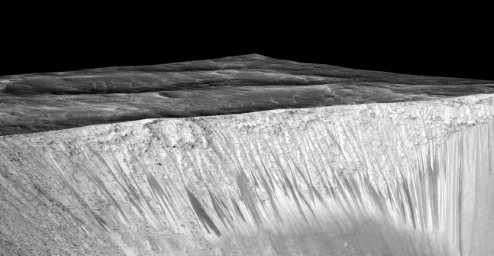
Figure 19.6 |
Dark streaks of flowing water on the side of the Garni Crater on Mars, an image created using data from NASA’s Mars Reconnaissance Orbiter. |
NASA’s Phoenix spacecraft launched in 2007 and successfully landed on Mars in 2008. The ESA’s Rosetta spacecraft passed Mars in 2007, on its way to comet Churyumov-Gerasimenko, and NASA’s Dawn spacecraft passed Mars in 2009, on its way to the asteroid belt. The China National Space Administration (CNSA) attempted to put Yinghuo-1 in orbit around Mars in 2011 but the mission failed to leave orbit around the Earth.
NASA has since sent two more probes to Mars, the Mars Science Laboratory and the MAVEN (Mars Atmosphere and Volatile EvolutioN) orbiter. Both are still in operation. The Mars Science Laboratory launched in 2011 and landed its rover, Curiosity, in 2012. MAVEN launched in 2013 and began studying the Martian atmosphere in 2014.
The Indian Space Research Organisation (ISRO) launched the Mars Orbiter Mission, also known as the Mangalyaan orbiter, in 2013. It began orbiting Mars the following year and is also still in operation.
The ESA and the Russian Federal Space Agency launched ExoMars in March 2016. This is currently looking for evidence of past or present life on Mars.
NASA's InSight (the Interior Exploration using Seismic Investigations, Geodesy and Heat Transport lander) landed in 2018 and is currently studying Mars's geology.
There are currently also many private missions to Mars being planned including crewed missions.
19.3.1 Potential crewed missions to Mars
Europe, Russia, and China
In 2001, the ESA laid out a long-term plan that would eventually lead to a crewed mission to Mars, although it has no predicted launch date. The ESA teamed up with Russia and China to conduct the Mars-500 experiment from 2007 to 2011. This involved three crew members living in a simulated environment, first a simulated transit vehicle and then a Martian habitat, for up to 17 months at a time. It was considered a success.
NASA
NASA has been considering crewed missions to Mars since 1987 when they announced that they would aim to put humans on Mars by the 2020s. This goal was approved by President Ronald Reagan in 1988 and by President George H. W. Bush in 1989. These ideas were put aside in the 1990s, and human exploration was removed from NASA’s agenda in 1996. That same year, NASA engineer Robert Zubrin released The Case for Mars, a book based on a research paper he wrote with fellow engineer David Baker in 1990. Zubrin went on to form the Mars Society.
In 2004, President George W. Bush announced that human exploration was back on NASA’s agenda, suggesting that a lunar outpost may be developed in the 2020s. In 2010, President Barack Obama predicted that NASA would launch a crewed mission to an asteroid in 2025, and put people into orbit around Mars by the mid-2030s, with a crewed mission to the surface to follow.
The Mars Society
The Mars Society is a non-profit organisation based in the USA, with chapters around the world. It was founded by NASA engineer Robert Zubrin in 1998. The Mars Society’s proposal to eventually colonise Mars is based on a research paper Zubrin wrote with fellow engineer David Baker in 1990. They claim that a crewed mission to Mars, known as Mars Direct, is possible with current technology at a total cost of $30 billion. Buzz Aldrin, the second person to walk on the Moon, is a member of the Mars Society Steering Committee.

Figure 19.7 |
Sand dunes on Mars, images taken by the Mars Reconnaissance Orbiter. |

Figure 19.8 |
Mars’ north pole, an image taken by the Mars Reconnaissance Orbiter. |
19.4 Colonising Mars
19.4.1 Physical requirements
A one-way crewed mission to Mars will require,
- A rocket and spacecraft for every mission.
- A habitable space for people to live and work with a functioning life support system.
- Mars suits so that people can leave the habitat.
- Mars rovers so they can travel further and carry specimens and specialist equipment.
- A communications system so they can interact with people on Earth.
Many of these things will be relatively easy to make. Mars Suits are pressurised suits that supply the astronauts with oxygen, just like normal space suits. The Mars rovers would be very similar to the lunar rovers that were taken to the Moon, and a communications system would consist of satellites conveying information at the speed of light (leading to a delay of between 3 and 20 minutes).
The biggest challenges will probably be the rocket and spacecraft and the life support system. The spacecraft will need to provide protection against the large doses of solar radiation that can occur sporadically, but this problem can be solved by building a reinforced shelter the astronauts can wait in.[8]
Landing a spacecraft on Mars will be more difficult. Mars has an atmosphere, and so you cannot use the same method that NASA used to land people on the Moon. Previous missions to Mars have always used a parachute to slow their descent. Yet the atmosphere is so thin that it can only slow about a tonne to the right speed, and anything heavier is destroyed. It’s not yet known what the total weight of a crewed mission to Mars will be, but NASA estimates that you would need to land at least 40 tonnes worth of equipment at a time.[9]
This might be achieved with the Falcon Heavy launch system and the Dragon spacecraft, both designed by SpaceX. This possibility is currently being researched at NASA’s Ames Research Center.[10]
In 2011, researcher John Karcz advised NASA that the Dragon would be able to safely deliver up to a tonne without using a parachute, and that supersonic retro-propulsion would allow it to carry even more.[11] Retro-propulsion involves firing rockets in the direction the craft is travelling to slow it down. To land safely on Mars, this will need to be done while the spacecraft is still travelling faster than the speed of sound.
A self-sufficient habitat will also be difficult to construct on Mars. It’ll need to be covered in layers of sand to protect the astronauts from radiation and incorporate a life support system that provides energy, food, water, and oxygen.
Solar panels could help provide the habitat with electricity, however, Mars is dusty, and the whole of the planet’s surface can be covered in dust storms for weeks. During this time, far less light will get through. When it’s safe to do so, people will have to use a rover to blow the dust away.
Inhabitants of Mars will have to grow their own food hydroponically, in greenhouses. There is water within the Martian soil, which they can collect using evaporation. Part of this water can be used for drinking, cleaning, and feeding crops, and part can be used to produce oxygen. The rest of the artificial atmosphere could be filled with inert gases nitrogen and argon. These can be extracted from Mars’ atmosphere.
19.4.2 Mental requirements
For a crewed mission to Mars to succeed, people will have to cope with the psychological strains of both isolation and confinement. The trip there will take about 7 months. It will be stressful, as the astronauts will have very little personal space, there will be constant noise, they will be unable to shower, and they will have to live on minimal rations of food and water. They may have to spend days at a time in the small refuge designed to protect them from solar radiation and will have to exercise regularly to prevent osteoporosis.
Things will improve once they arrive in their living habitats. They will be able to wear normal clothes, shower, grow and cook fresh food, and begin work researching Mars. Although they’ll still not have much of a view since the habitats must be covered in layers of sand to prevent radiation poisoning, and if anything does go wrong they will have to solve the problem themselves. Once there, the Earth will be just another star in the sky.